RRP-235
Antique Edo Japanese Shunga Woodblock Prints Pair Utagawa School 19th C
Request Access← Back to CollectionInquire about this object →Catalogue entry
Description
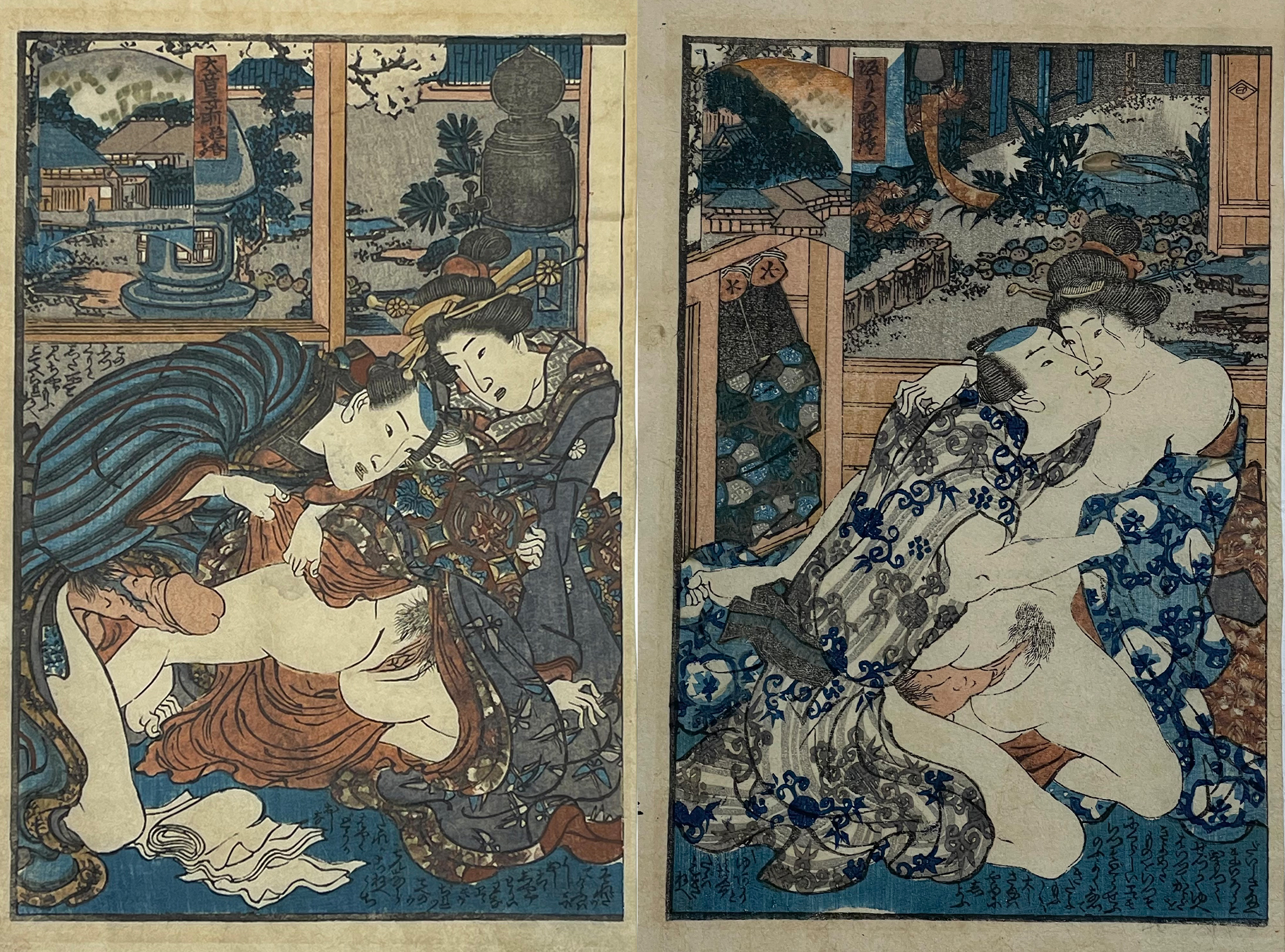
A matched pair of Japanese Edo-period polychrome shunga woodblock prints, attributed to the Utagawa School, Toyokuni lineage, early 19th century, c. 1810–1835.
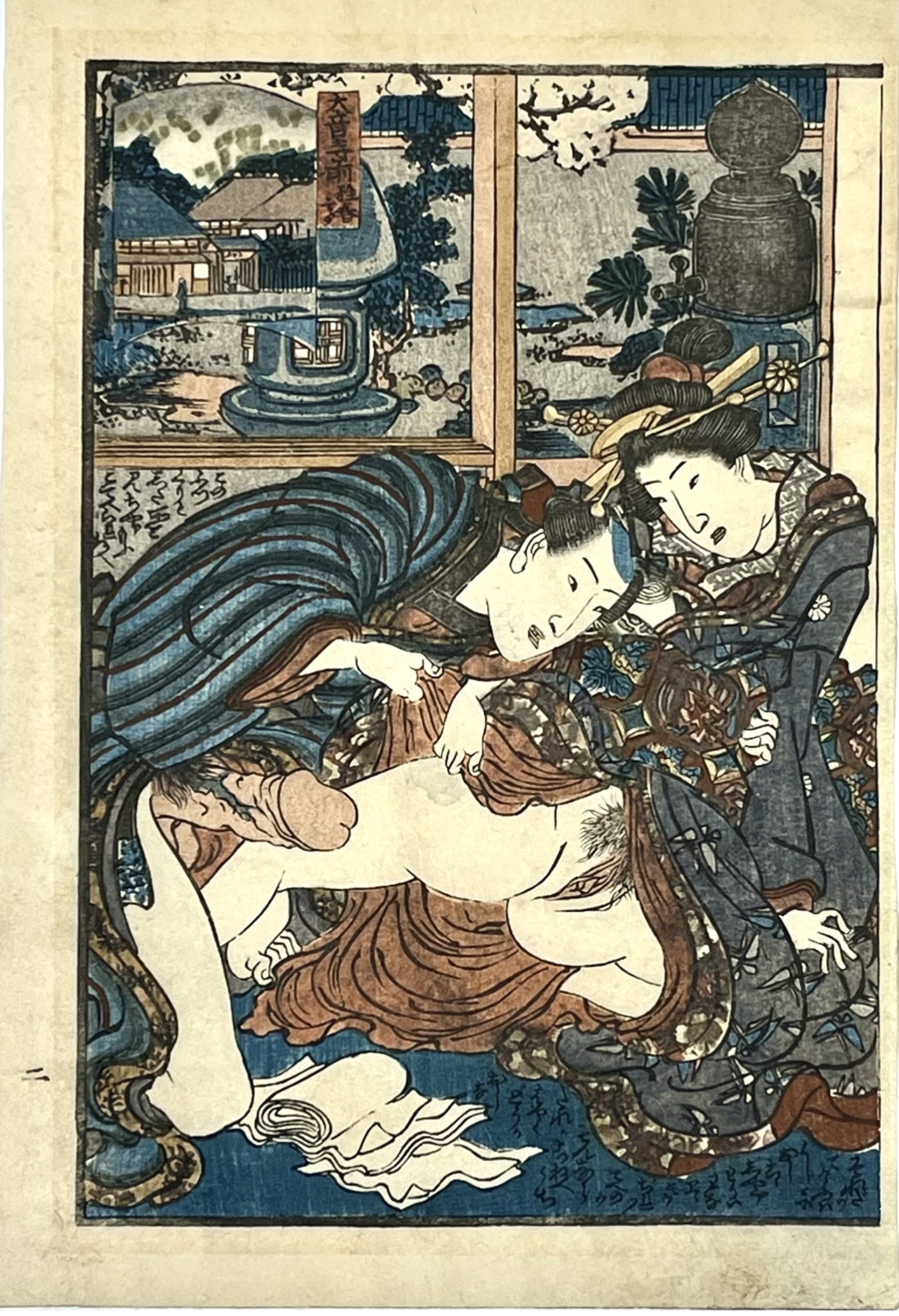
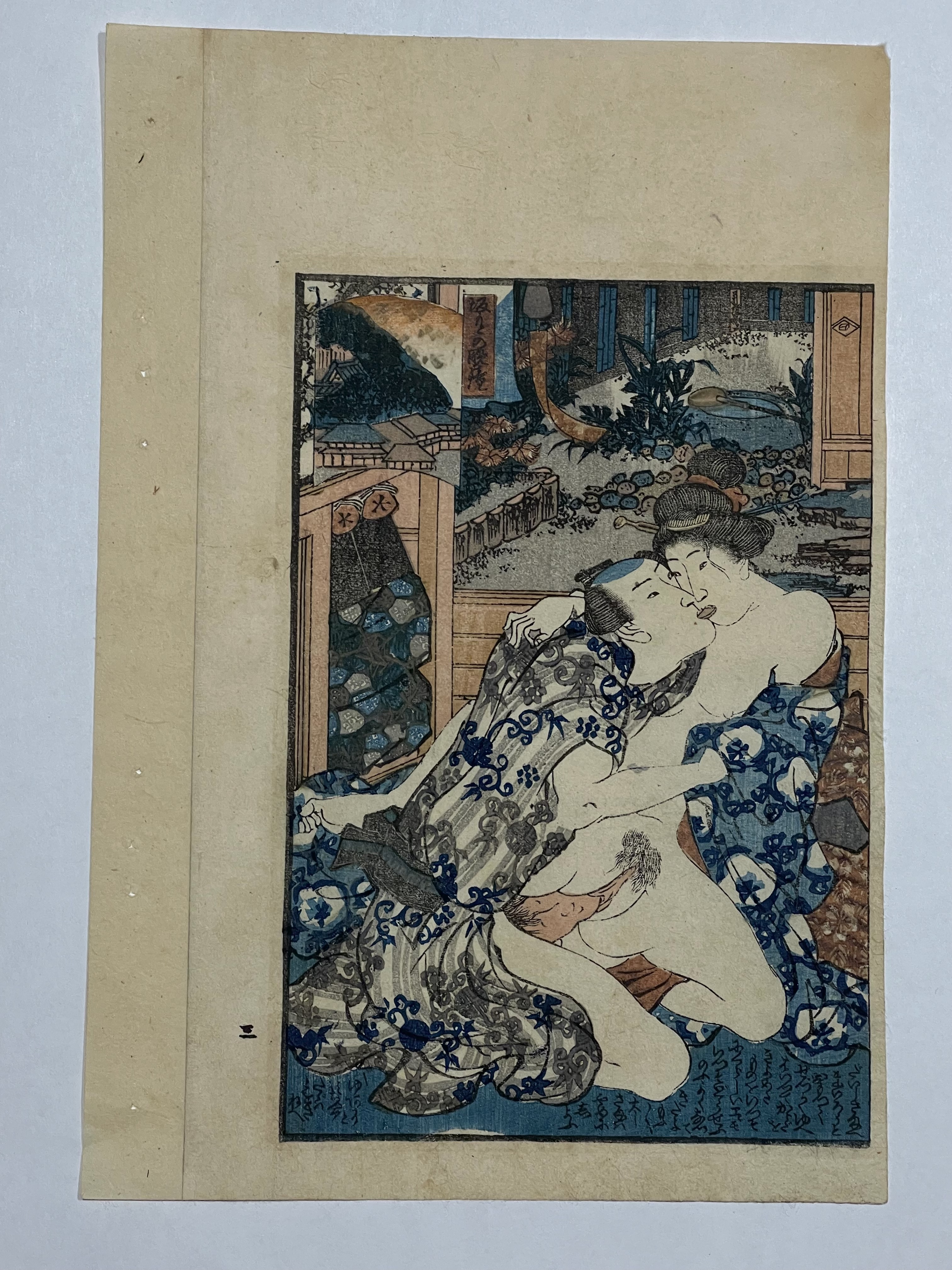
The two prints share closely related artistic characteristics, including figure construction, facial types, elaborate textile patterns, architectural settings, and carefully composed garden landscapes. Their consistent dimensions, visual vocabulary, and printing characteristics suggest that they originated within the same artistic production, possibly as leaves from a larger illustrated shunga album or series.
Both compositions depict intimate encounters within richly detailed domestic interiors opening onto landscaped gardens.
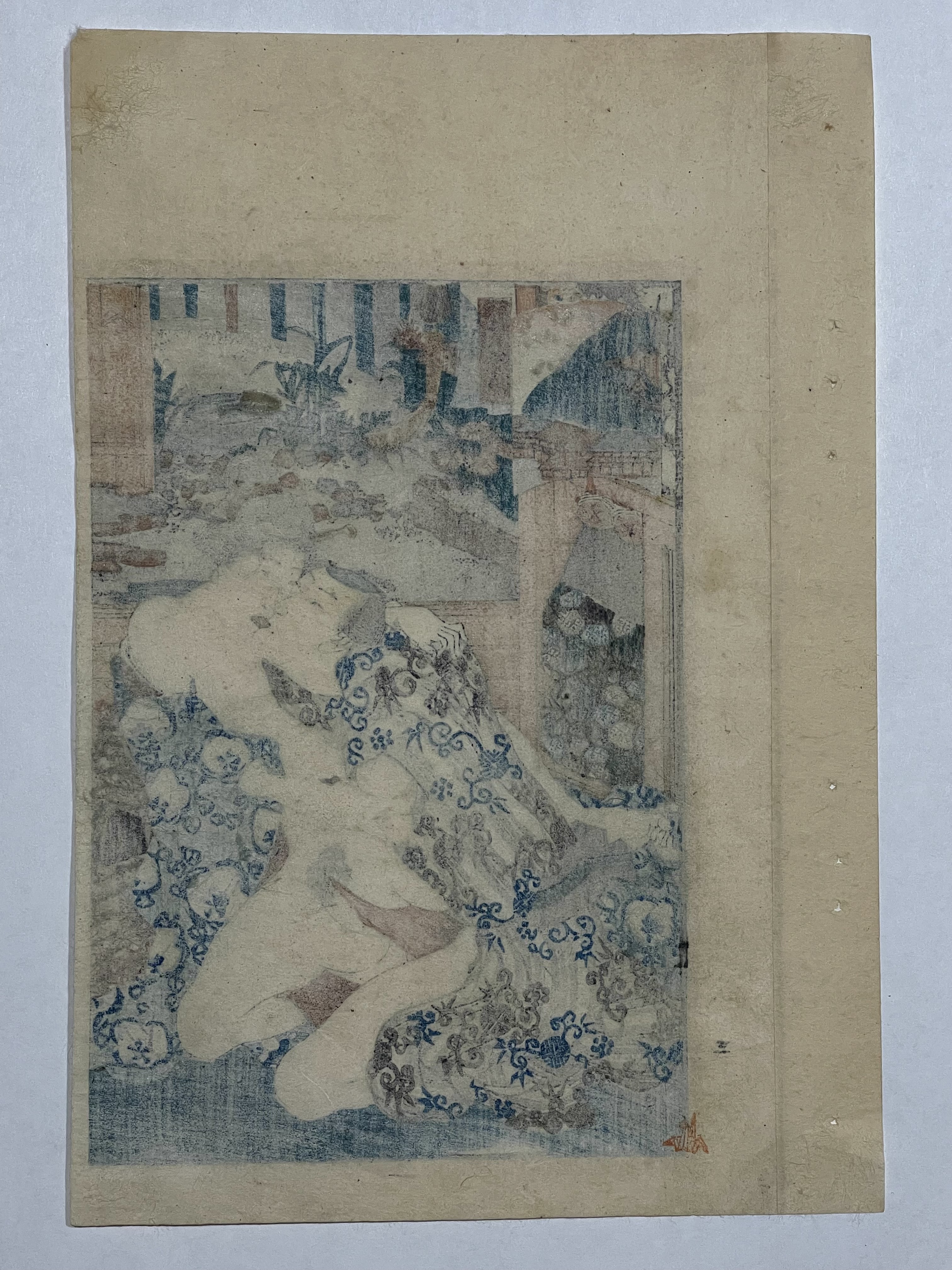
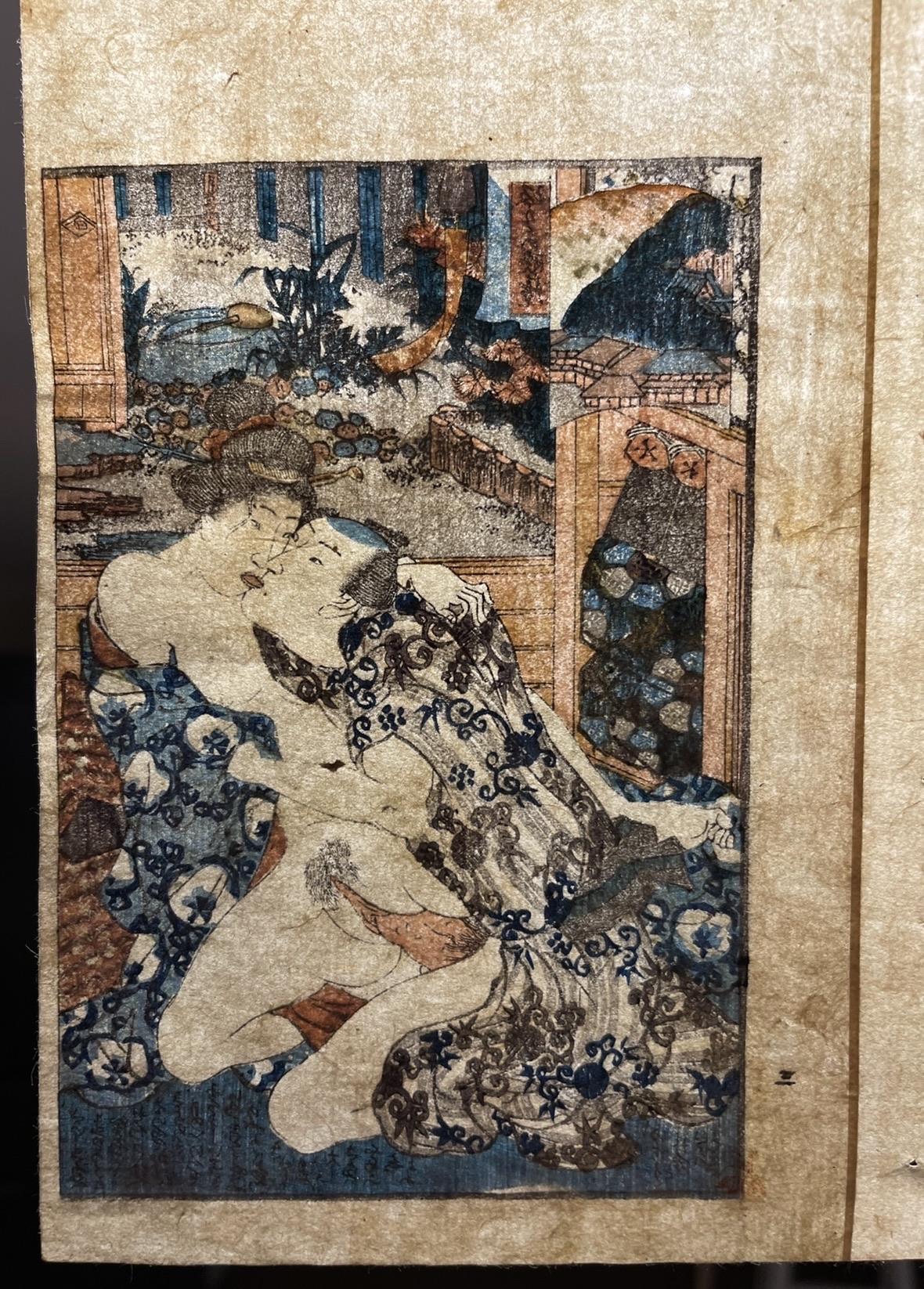
In the first print, an embracing couple occupies the foreground, their intertwined bodies partially enveloped in elaborately patterned textiles. Beyond the architectural framework, a carefully arranged garden contains rocks, vegetation, water features, and traditional buildings.
The second print presents a more complex arrangement of figures, surrounded by flowing garments and decorative textiles. The background incorporates garden architecture, stone lanterns, foliage, and distant buildings.
In both works, the artist establishes a deliberate relationship between the intimacy of the foreground and the visual harmony of the surrounding environment.
The restrained palette of blues, browns, grays, and muted earth tones unifies the figures, textiles, and landscapes.
Construction and Printing
Both works are multicolor woodblock prints on thin Japanese paper, consistent with traditional handmade washi.
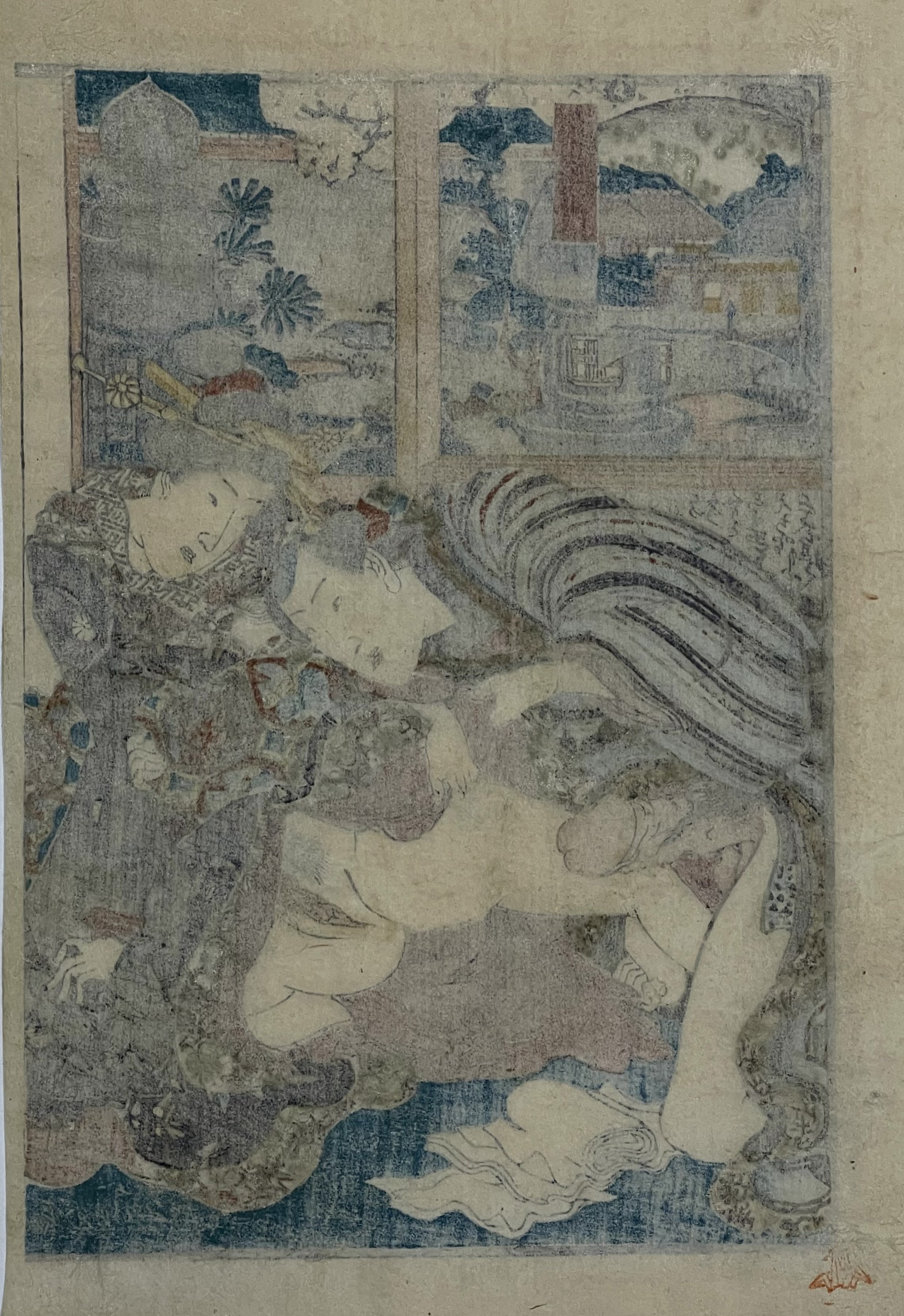
The reverse and transmitted-light views reveal the penetration of printing pigments through the paper, irregular paper translucency, and characteristics consistent with traditional Japanese hand-printing techniques.
The prints preserve fine contour lines, intricate textile ornamentation, and delicate facial details.
The surviving impressions and paper characteristics support their attribution to historical Japanese woodblock production.
The sheets display age-related toning and wear consistent with their history as individually preserved prints.
Cultural Attribution
Japan — Edo Period. Utagawa School, Toyokuni lineage.
Attributed to Utagawa Kunimori II (歌川国盛二代), or a closely associated Utagawa workshop artist.
The attribution is supported by comparisons with Utagawa-school figure construction, textile ornamentation, and the integration of intimate foreground scenes with architectural and landscape settings.
A particularly relevant comparative reference is the shunga publication Azuma Meisho Nijūhakkai (東名所二十八景), associated with Utagawa Kunimori II.
Utagawa Kunisada (Toyokuni III) provides another relevant stylistic comparison within the broader Toyokuni artistic lineage.
Dating
Edo Period, Early 19th Century, c. 1810–1835.
The proposed dating is based on the combined characteristics of the compositions, figure styles, hairstyles, textile patterns, printing techniques, and paper.
Collector's Note — Rarity & Significance
These two prints are preserved and offered together because of their close artistic, technical, and compositional relationship.
Their shared visual language suggests a common artistic origin and makes the pair particularly valuable for comparative study.
Beyond their importance as examples of Japanese erotic woodblock printing, the compositions offer an opportunity to examine the relationship between sexuality, aesthetics, and social conventions in Edo-period visual culture.
Particularly significant is the integration of intimate encounters within idealized domestic and garden environments.
The surrounding architecture, vegetation, decorative textiles, and carefully balanced landscapes create an atmosphere of beauty and harmony that visually absorbs the erotic encounter into an ordered environment.
This relationship invites interpretation through gender studies and visual-culture scholarship, particularly concerning the ways aesthetic harmony may normalize or obscure social and sexual power relationships.
The pair also offers comparative possibilities with Persian, Mughal, and Ottoman erotic and courtly imagery, where idealized gardens, architectural refinement, and decorative luxury frequently frame representations of intimacy.
The two prints are preserved as a pair, retaining their artistic and historical relationship.
Condition
Antique condition with age-related paper toning, discoloration, surface wear, and minor imperfections. Both prints retain their original compositions, detailed linework, and substantial surviving color. Reverse surfaces show pigment penetration and evidence of age. Please examine all photographs, including the reverses and transmitted-light views, as part of the condition description.
Photographic gallery

Access & use
Ways this object may be engaged
Educational Programs (No loan fee)
Exhibitions (No loan fee)
Editorial — for books, articles, scholarly journals (No loan fee)
Film / TV
(Rental fees apply)
Advertisement / Commercial Photography
(Rental fees apply)
Prestige Rentals
Distinguished objects available for short- or long-term rental to private residences, offices, hotels and exceptional spaces.
(Rental fees apply)
Documentation