RRP-234
Antique Japanese Edo Shunga Erotic Woodblock Print Flute Lovers c. 1770–1830
Request Access← Back to CollectionInquire about this object →Catalogue entry
Description
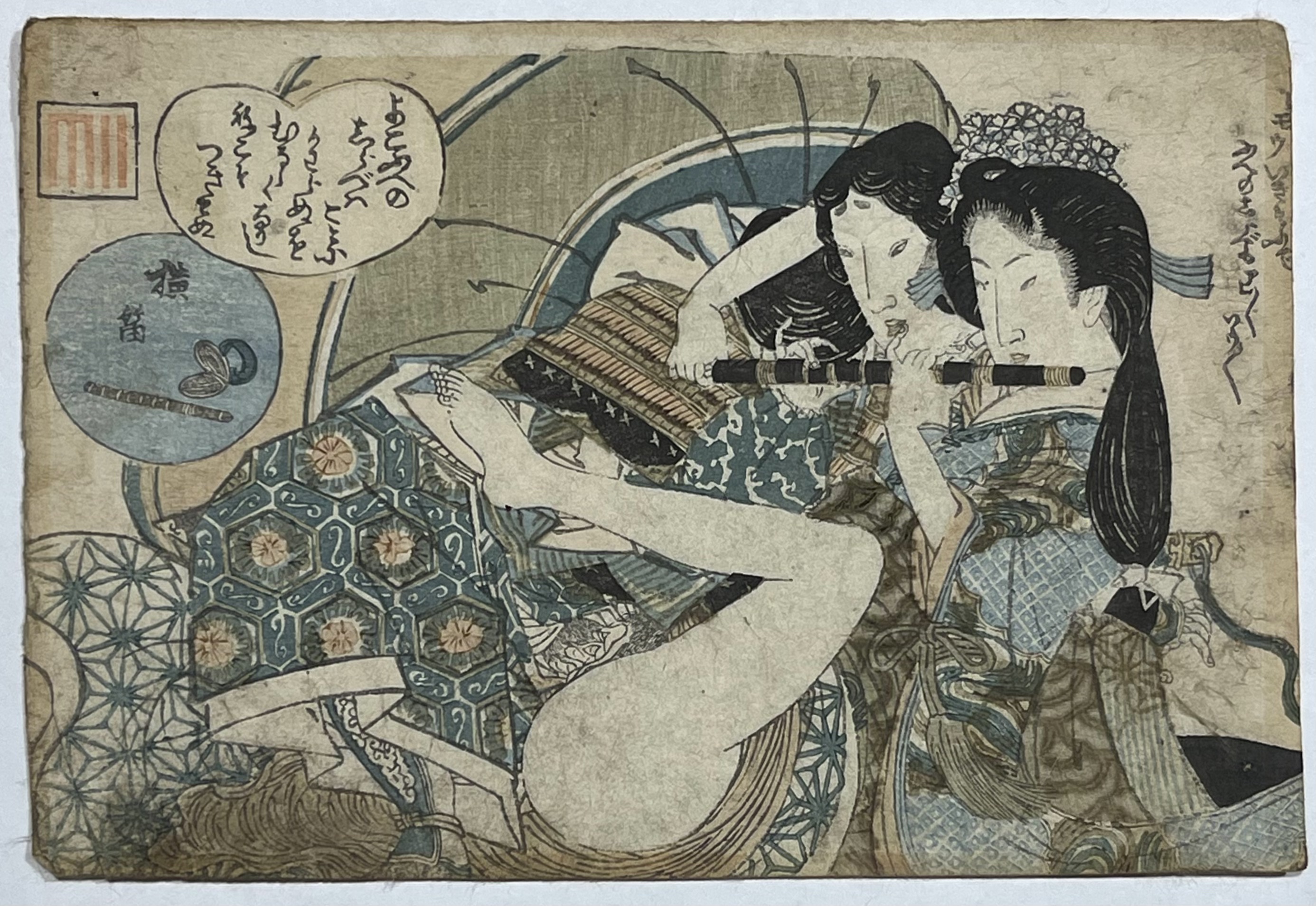
An antique Japanese shunga (erotic art) polychrome woodblock print, attributed to the late Edo period, approximately 1770–1830, depicting an intimate encounter between two figures in which the woman plays a transverse flute.
The composition is distinguished by its integration of musical performance and erotic intimacy.
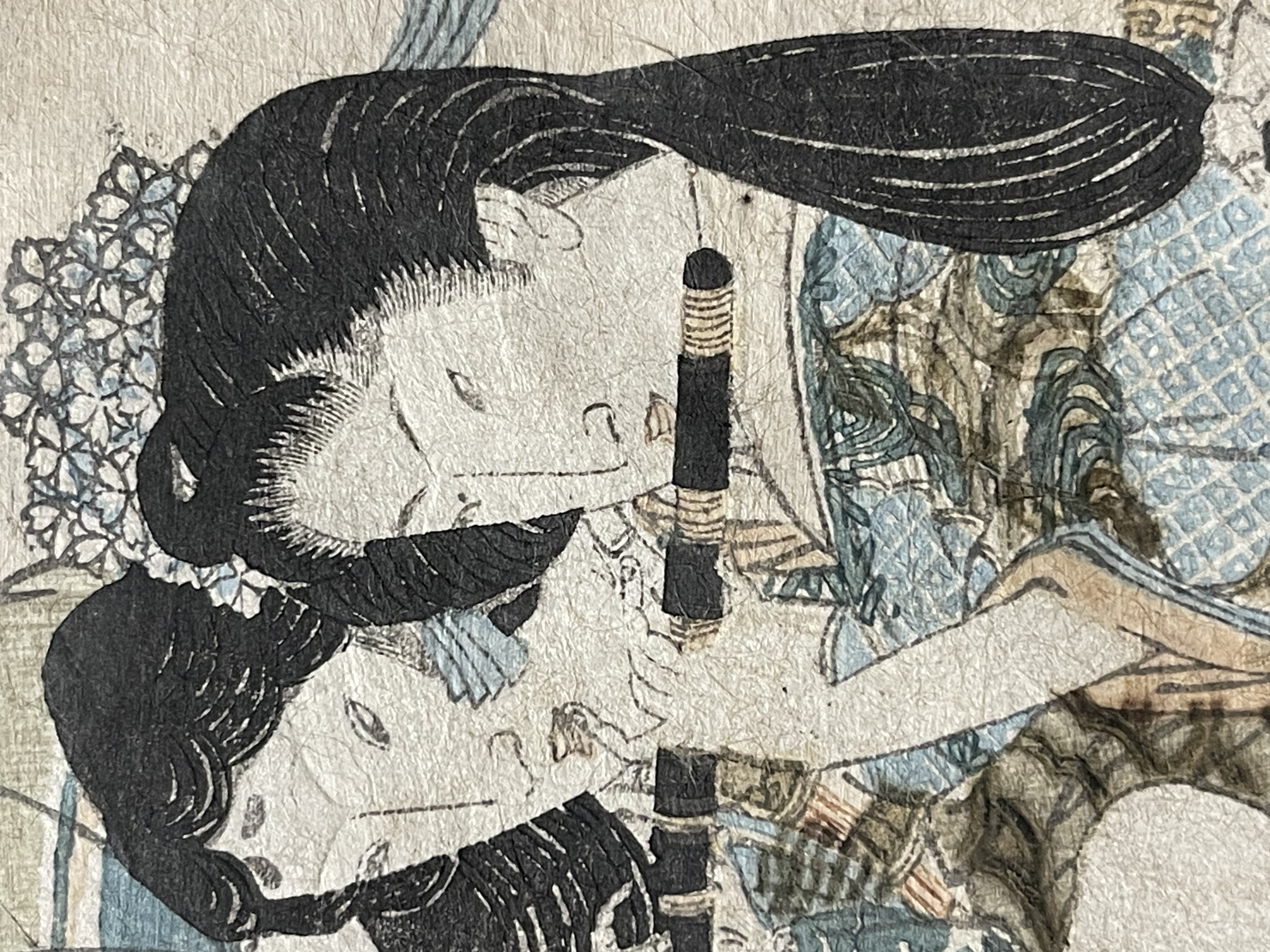
The woman holds the flute horizontally to her mouth while remaining physically engaged with her partner. Particularly noteworthy is the subtle interaction between their faces and hands: her little finger appears to touch his lower lip, while his extended tongue suggests sensual responsiveness.
This carefully observed gesture introduces a second dimension to the encounter. The woman simultaneously performs music and engages her partner through touch, creating a playful correspondence between musical technique and erotic pleasure.
The artist brings together the cultivated refinement of musical performance and the immediacy of physical desire within a single composition.
Artistic Treatment
The print displays sophisticated figure drawing and unusually elaborate textile decoration.
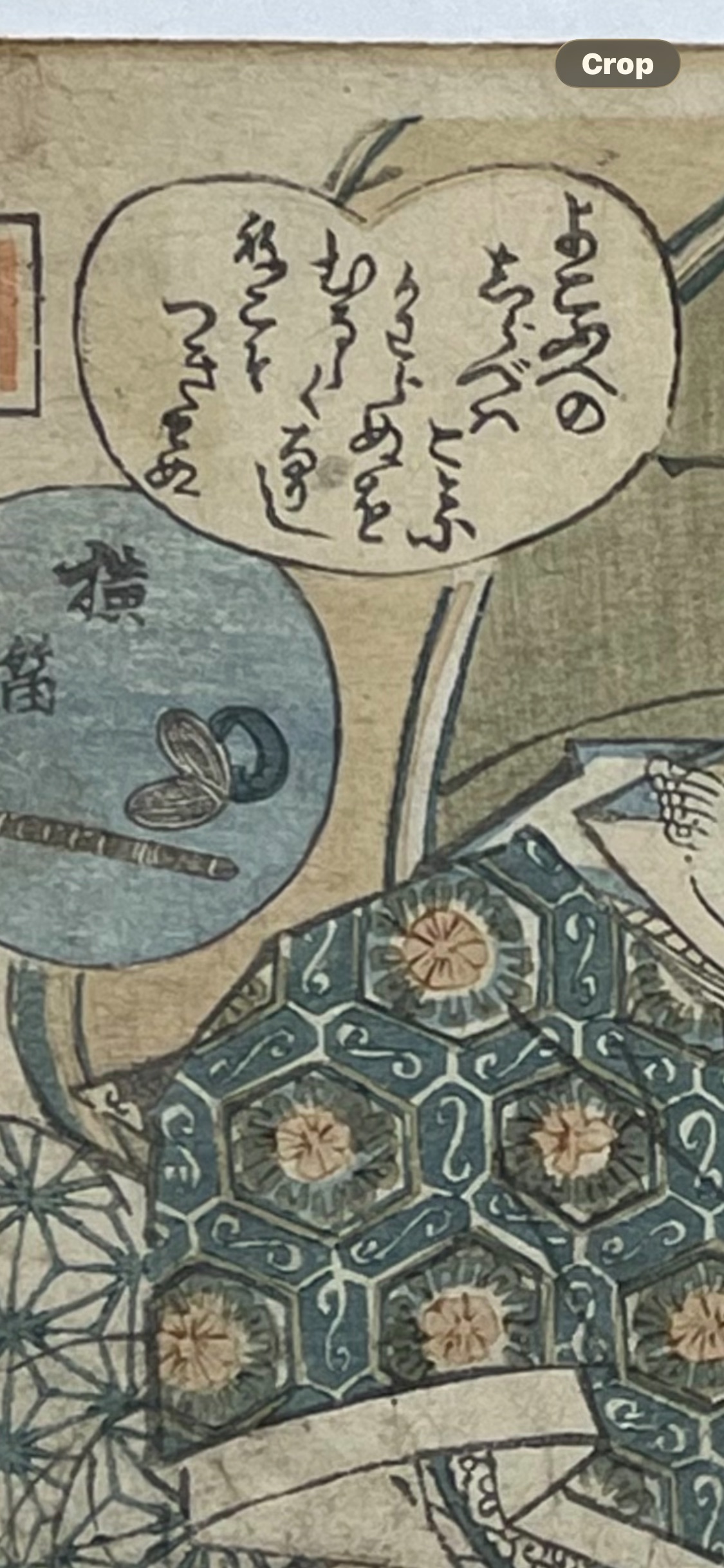
The garments incorporate geometric grids, interlocking hexagonal arrangements, floral medallions, and flowing ornamental patterns. These densely organized designs contrast with the relatively open areas of exposed skin, creating a carefully balanced visual rhythm.
The restrained palette consists principally of delicate blue and blue-green, ocher, warm brown, dark green, pale reddish-orange, and black.
The treatment of the hair is particularly refined, with numerous fine, controlled strokes distinguishing individual strands from the larger dark masses. The delicate facial drawing and expressive hand gestures demonstrate considerable attention to detail.
Pigments and Printing Technique
The print appears to have been produced using traditional multiblock color woodblock printing techniques (nishiki-e) on thin Japanese paper.
The delicate, translucent blue is visually consistent with traditional dayflower (aobana) coloring, widely employed in eighteenth-century Japanese printmaking.
Before the widespread adoption of imported Prussian blue around 1830, dayflower was an established means of producing subtle, translucent blue effects.
The limited availability and relatively high cost of early imported Prussian blue would have offered little practical advantage for achieving the restrained tonal effect seen here.
The color vocabulary and historical economics of pigment selection therefore favor an eighteenth-century printing tradition, particularly the earlier portion of the proposed dating range.
Inscriptions and Graphic Elements
The composition incorporates several distinct textual and decorative features.
A blue circular panel contains two Japanese characters apparently reading 横笛 (yokobue, transverse flute), accompanied by an illustration of the instrument and additional small objects.
A lobed, heart-shaped cartouche contains several columns of cursive Japanese writing.
A separate vertical inscription appears along the right margin.
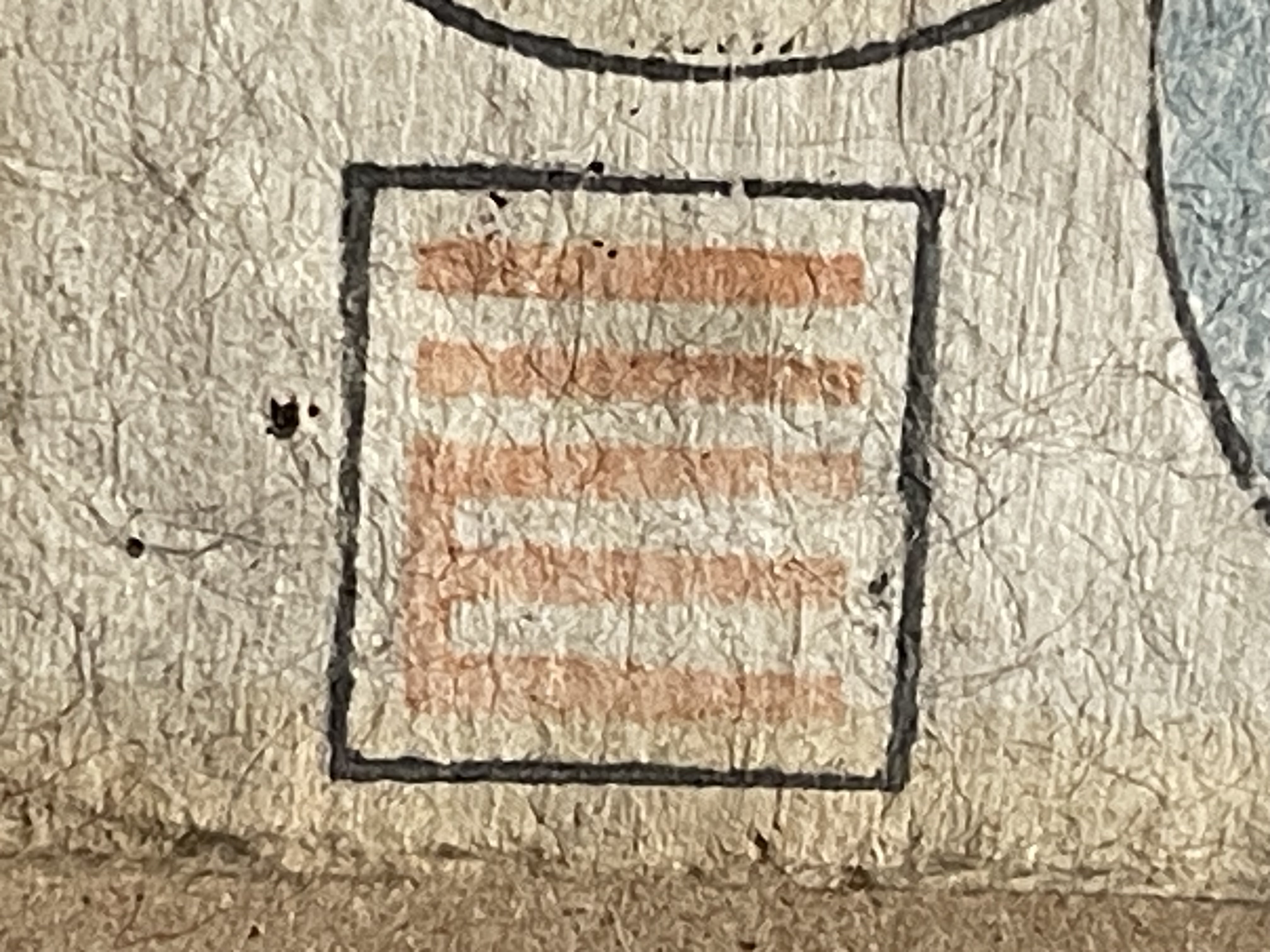
A small red rectangular emblem contains five vertical strokes, with three apparently connected at the top.
The longer inscriptions remain undeciphered, and no specific literary attribution is assigned.
Paper and Physical Characteristics
The print is executed on thin, fibrous paper consistent in appearance with traditional Japanese washi.
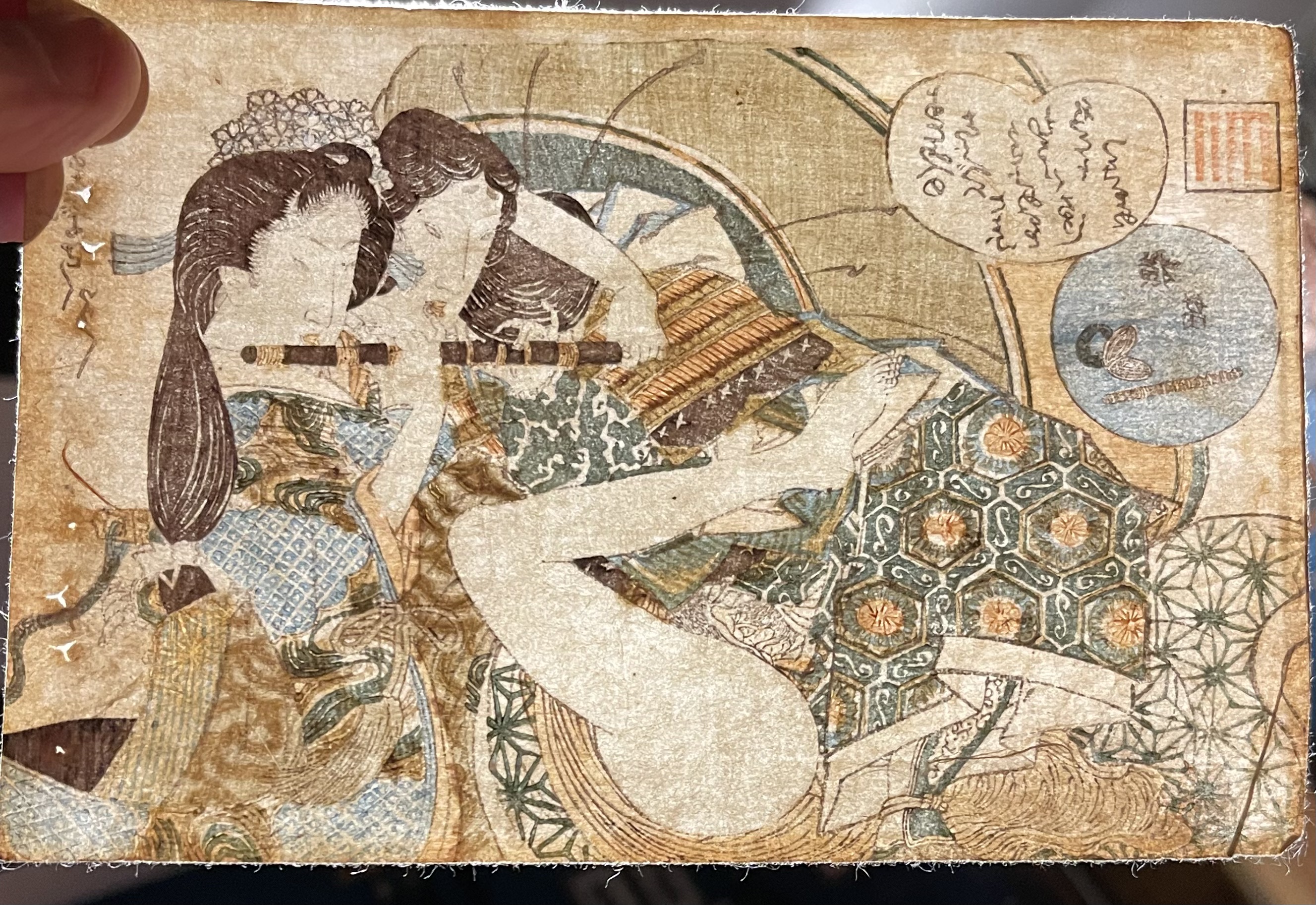
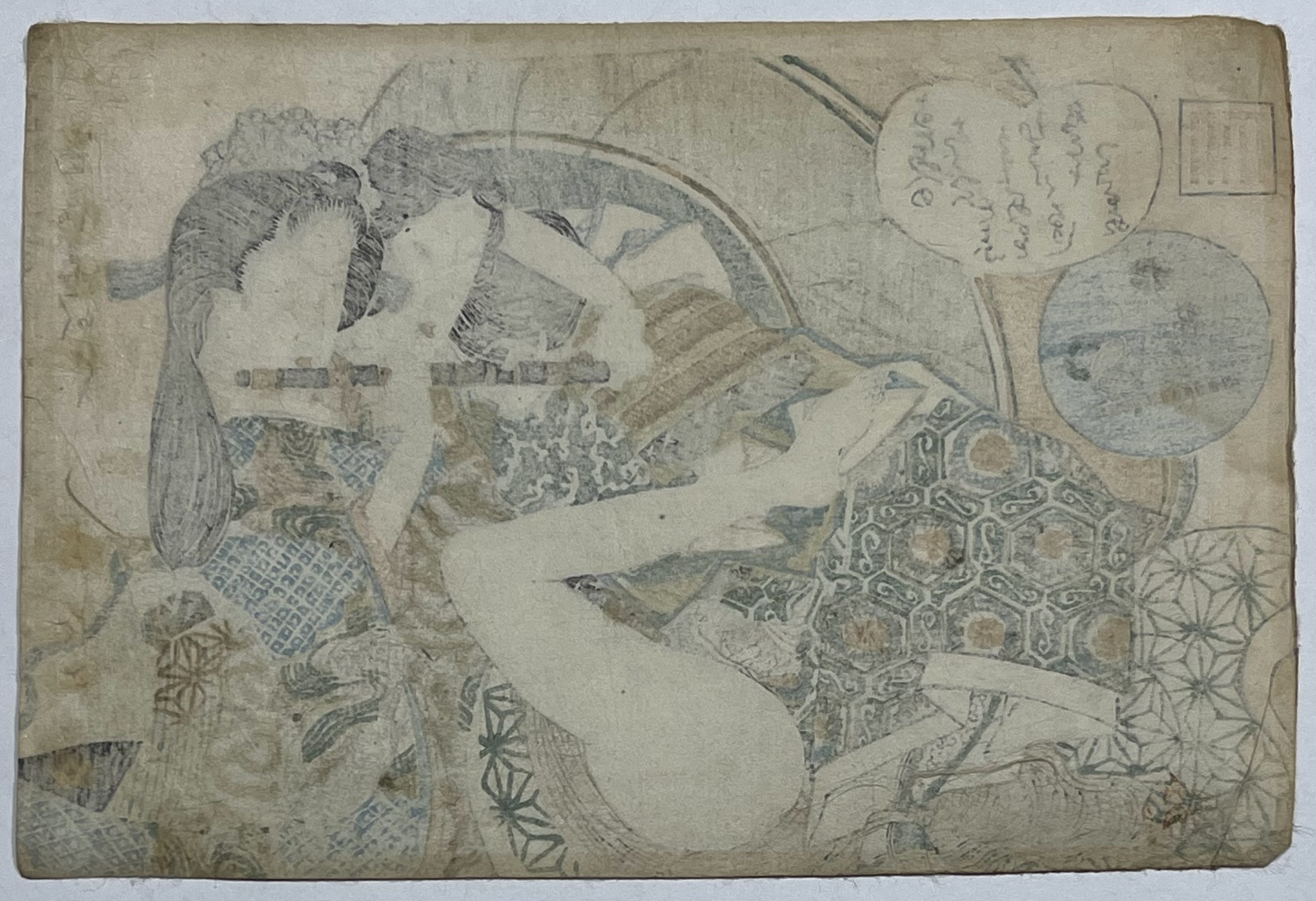
Transmitted-light examination reveals irregular paper fibers and variations in thickness. The reverse shows a faint image of the printed composition, particularly in the darker areas.
The sheet exhibits substantial age-related toning, localized staining, and wear, while retaining much of its fine printed detail.
Dating
Period: Late Edo period. Date: Approximately 1770–1830.
Stylistic and Technical Assessment: The delicate color printing, elaborate textile patterns, refined figure drawing, and translucent blue palette favor the earlier portion of the proposed dating range.
Collector's Note — Rarity and Significance
The particular artistic interest of this print lies in its treatment of simultaneous musical and erotic activity.
The transverse flute is central to the composition rather than an incidental accessory. The woman's musical performance becomes part of the intimate encounter itself.
The interaction between her playing hand and her partner's mouth creates a second level of sensual communication, introducing a subtle visual joke concerning musical and erotic virtuosity.
The elaborate textile patterns, expressive figure drawing, restrained palette, and integration of written elements contribute to the print's sophisticated character as an example of Japanese erotic woodblock art.
The inclusion of a flute-related pictorial panel, cursive inscriptions, and a five-stroke emblem also suggests a composition intended for viewers familiar with Japanese literary and visual conventions.
The combination of musical subject matter, intimate physical gesture, and complex graphic presentation makes this an especially engaging example of Edo-period shunga.
Condition
Antique Japanese polychrome woodblock print on thin, fibrous washi paper. Age-related toning, scattered staining, pigment fading, surface wear, and minor edge irregularities. Fine details remain visible in the figures, hair, inscriptions, and patterned textiles. Please examine all photographs carefully as part of the condition description.
Photographic gallery

Access & use
Ways this object may be engaged
Educational Programs (No loan fee)
Exhibitions (No loan fee)
Editorial — for books, articles, scholarly journals (No loan fee)
Film / TV
(Rental fees apply)
Advertisement / Commercial Photography
(Rental fees apply)
Prestige Rentals
Distinguished objects available for short- or long-term rental to private residences, offices, hotels and exceptional spaces.
(Rental fees apply)
Documentation