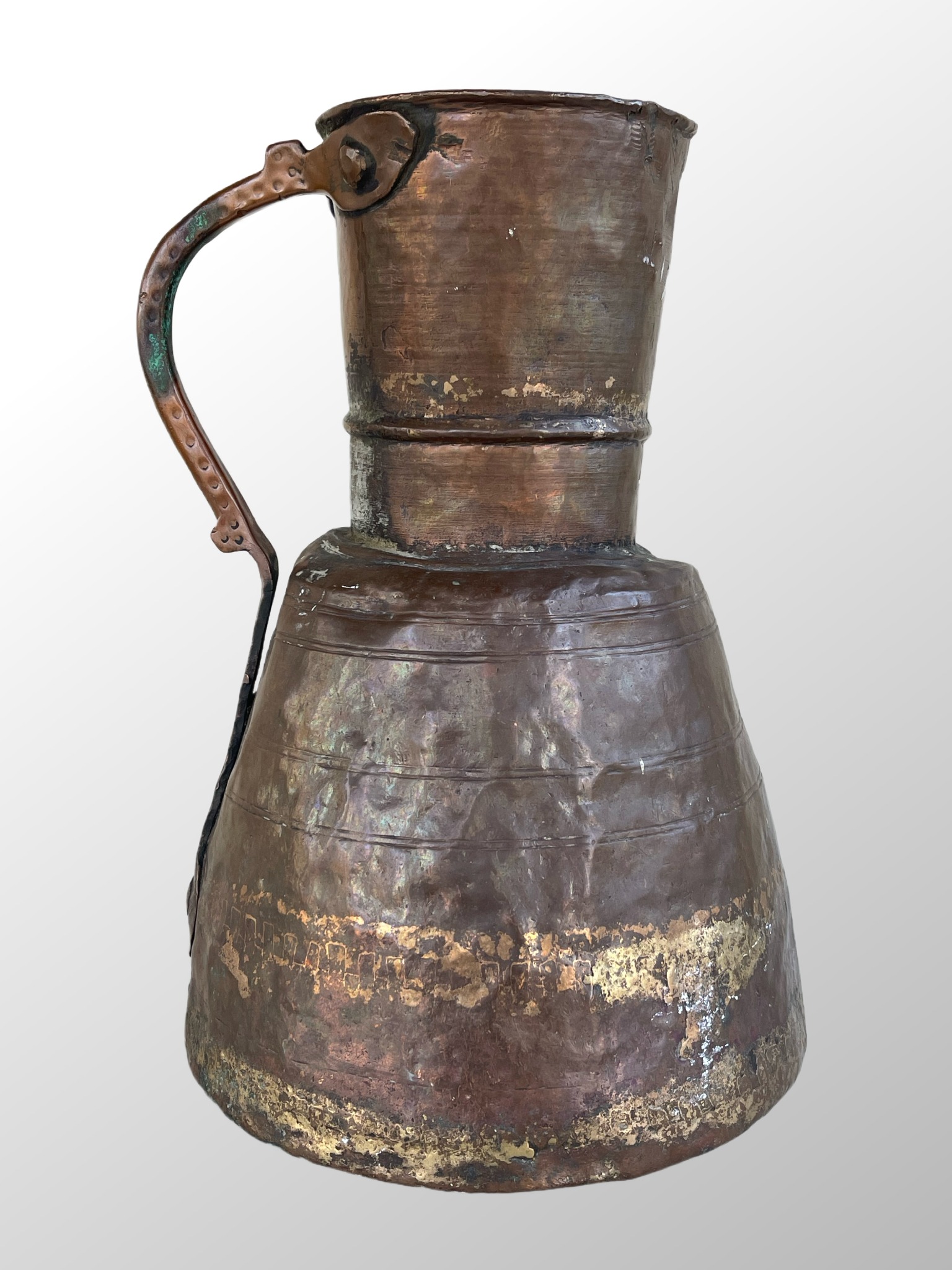
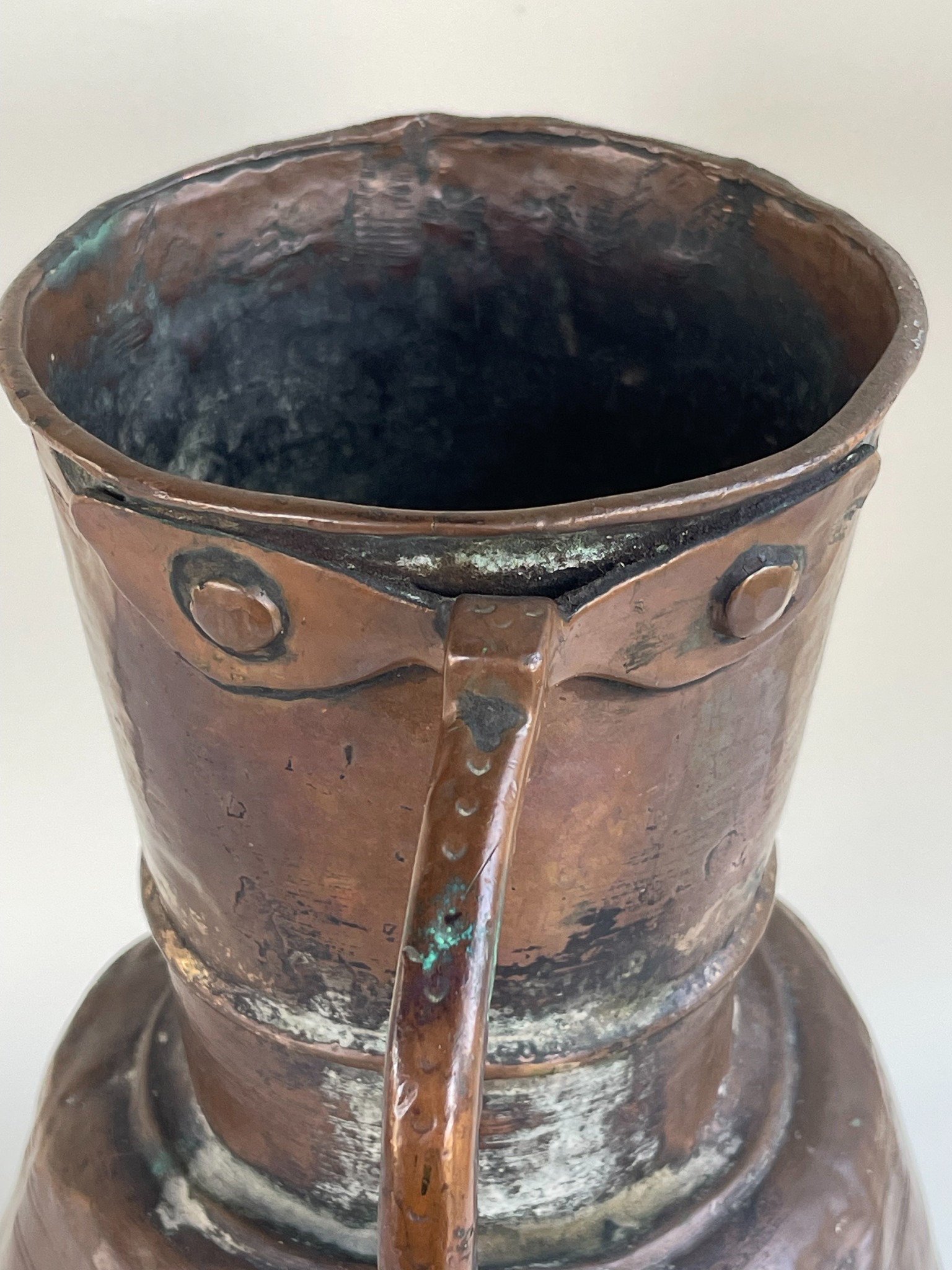
A substantial Ottoman water vessel with thick walls, a broad lower body, pronounced waist-like narrowing, flared upper neck, and robust riveted handle. Linear engraving decorates the handle, and a repetitive incised band encircles the body. Surviving gilded areas contrast with exposed metal, dark patina, and the layered effects of long use.
The wide opening is interpreted in the supplied study as suited to scooping warm water. Its substantial weight and broad base suggest a vessel kept in a stable position during use. Darkening on the underside is interpreted as evidence of direct heating over charcoal or a brazier. Metal patch repairs, attributed by the owner to the 19th century, record continued investment in maintaining the vessel.
The supplied attribution places manufacture in the Ottoman Empire, circa 1720–1780, with a proposed setting in an elite private hamam, possibly within a palace or harem. The surviving gilding, scale, form, and repair history are the basis of this interpretation. The particular household, original users, and ceremonial role remain unestablished.
Scholarly interpretation: The collector reads the vessel’s narrowed center and elongated neck as evocative of the feminine body, connecting its form to the sensory and symbolic dimensions of bathing in women’s quarters. Within this reading, the warming, scooping, and circulation of water become part of a larger account of intimacy, status, bodily care, and ceremony. Specific associations with concubines, enslaved women, noblewomen, or ritual preparation are interpretive possibilities rather than demonstrated object history.
Collector’s note: The vessel’s significance is especially tangible in its surviving finish, heat-darkened underside, and patch repairs. These layers suggest an object whose usefulness and material value justified sustained care. The proposed private hamam context gives this long working life an evocative human setting, while its physical construction and repairs remain central evidence for further study.
Reported condition: Structural integrity is preserved with extensive wear, patina, oxidation, and visible historic patching. Gilding survives in areas of the surface. The underside is blackened, and the lower body shows substantial surface alteration and repairs. No base stamp or calligraphy was observed by the owner.