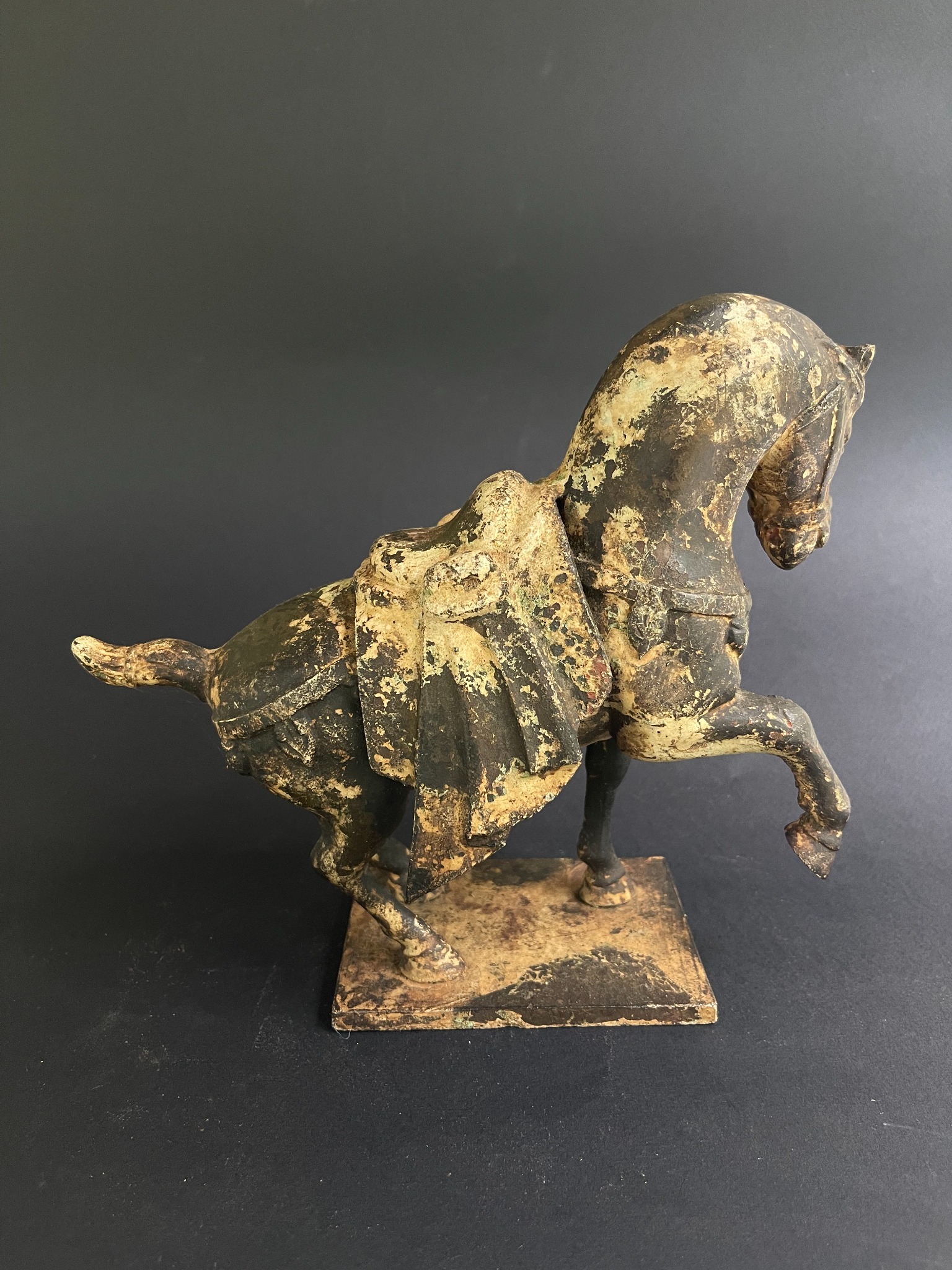
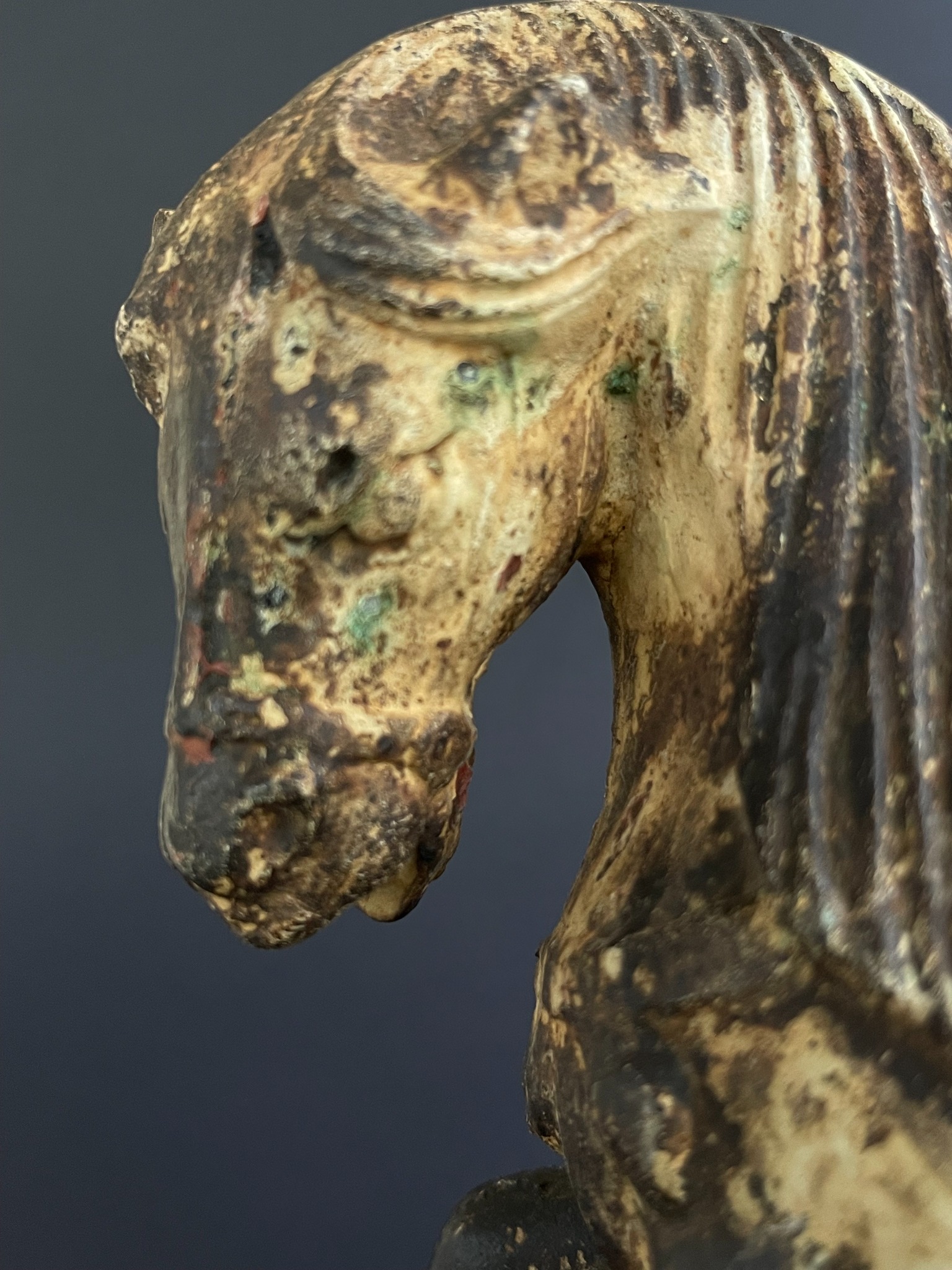
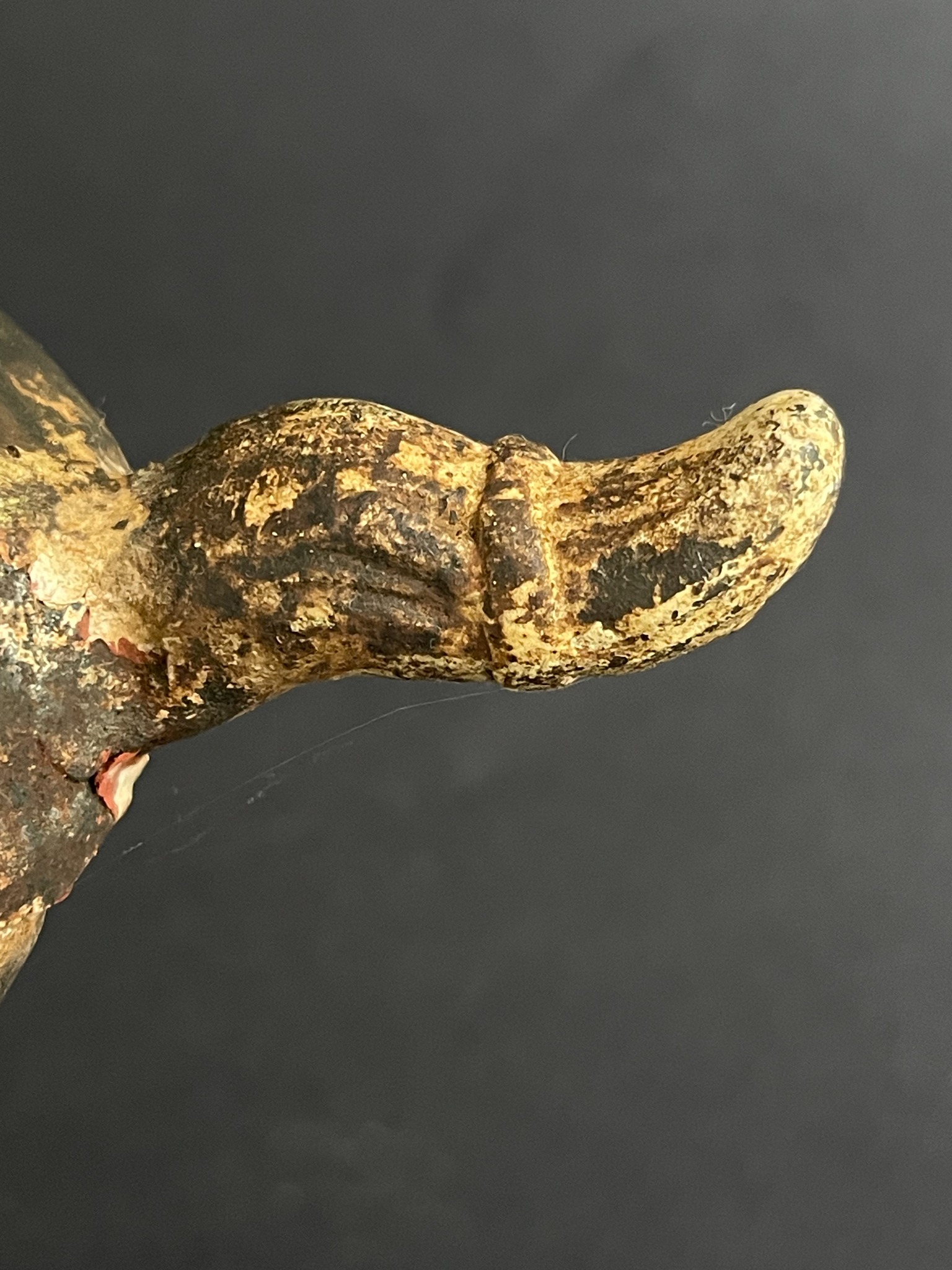
A richly caparisoned cast-iron prancing horse provisionally attributed to Qing China, circa 1750–1900, drawing upon the earlier Tang equestrian tradition. The horse stands on three supporting legs with one foreleg raised, a powerfully arched neck, expressive lowered head, deeply grooved mane, broad suspended saddle panels, and a gathered tail secured by a modeled binding before ending in an upward-curving tuft. The riderless composition concentrates attention on the animal’s disciplined movement and ceremonial presentation.
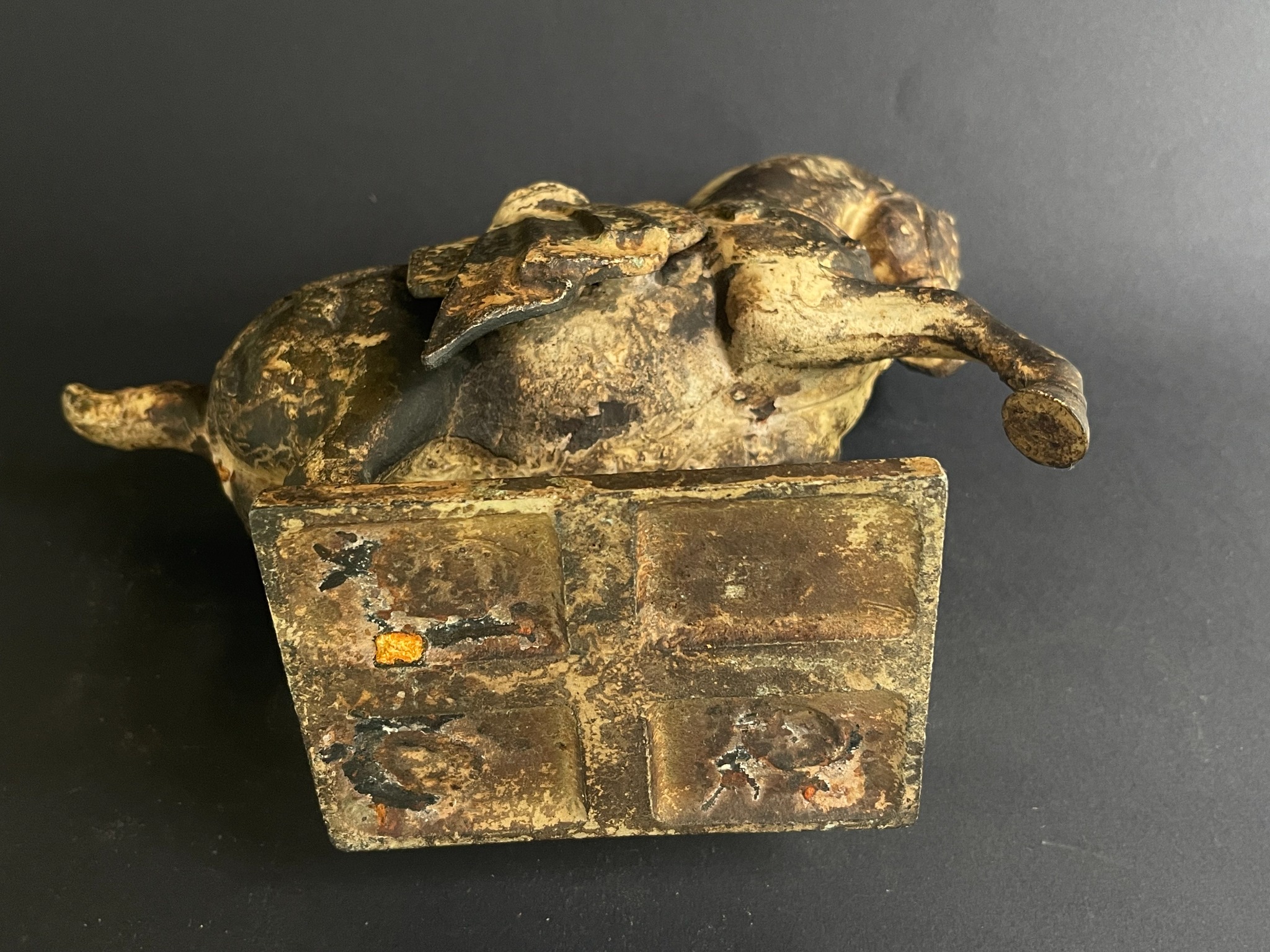
The rectangular cast-iron base appears purpose-built for the horse. Its underside incorporates a substantial cross-shaped reinforcement dividing four recessed compartments and extending toward the perimeter. Horse and base display closely related oxidation, wear, and decorative remnants, supporting their interpretation as a long-associated ensemble. Circular features within the underside compartments do not consistently align with the supporting hooves; their manufacturing function remains undetermined. Separate saddle elements and visible construction joints reveal a planned casting and assembly process.
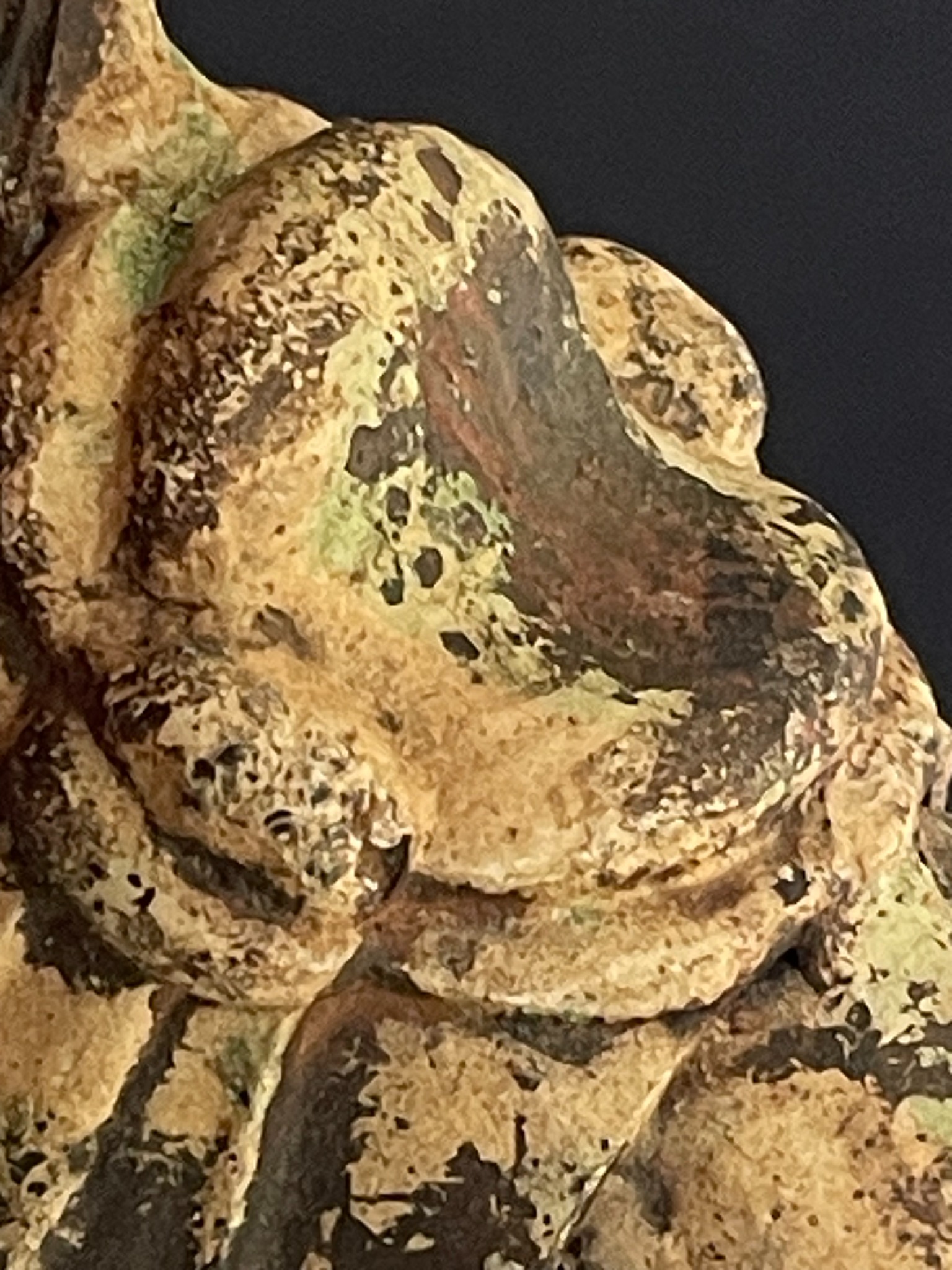
Historic surface remnants include dark coatings, pale cream-yellow decoration, and localized reddish pigment or deposits, with irregular losses exposing metal and corrosion. Pitting, abrasions, oxidation, and wear occur across exposed and recessed areas. The owner reports that the horse stands securely and that photographs show no obvious modern welded repairs or exposed contemporary fastening hardware. The surface remains preserved as evidence of the object’s material history.
The supplied cultural interpretation relates the arched neck, raised foreleg, elaborate furnishings, and bound tail to Chinese courtly horse imagery associated with prestige, trained movement, beauty, and cultivated power. The proposed Qing manufacture is distinguished from this earlier artistic vocabulary. Construction and surface history inform the provisional date, while the precise manufacturing chronology remains open to technical investigation.