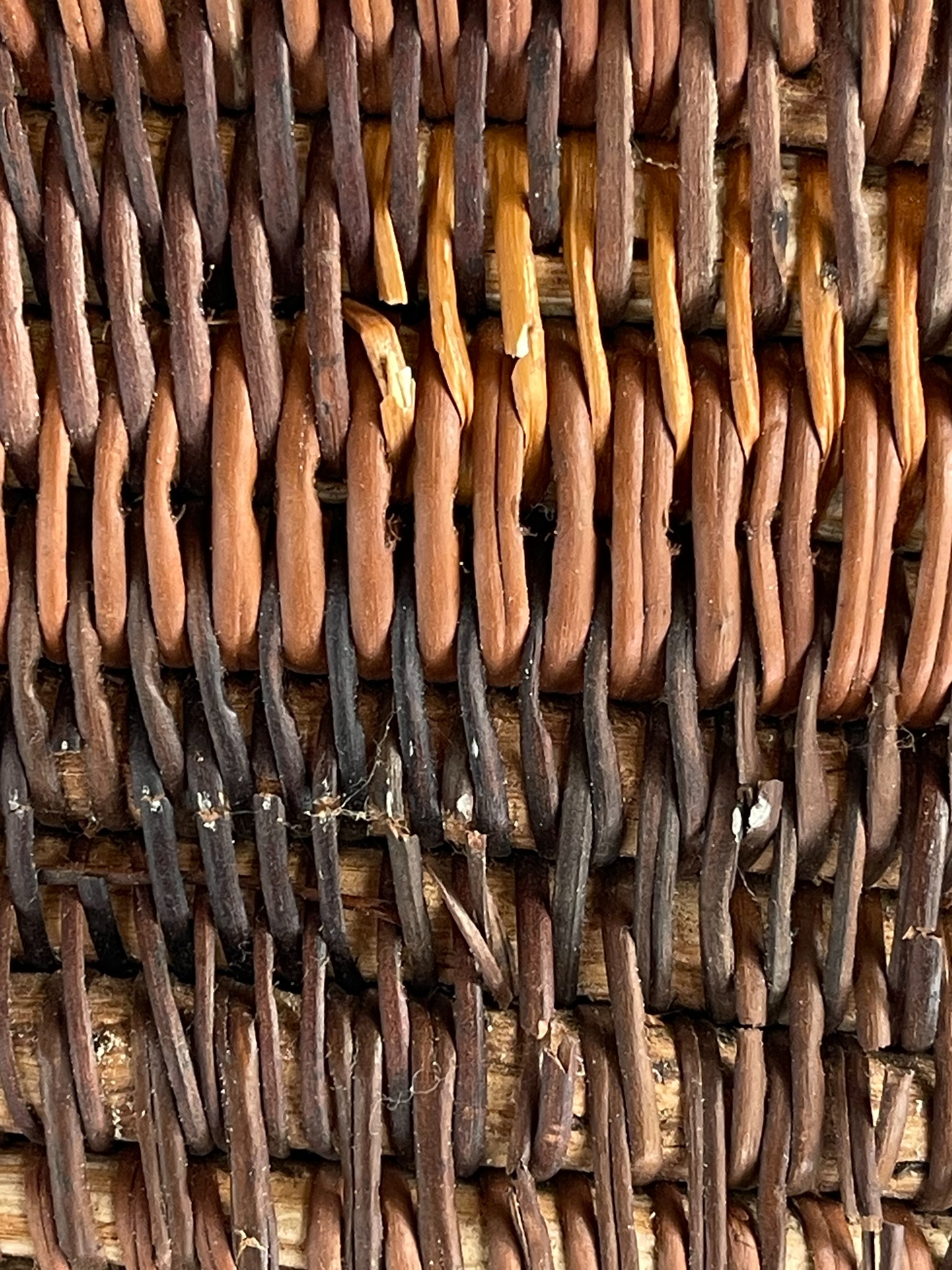
A substantial globular lidded storage basket attributed to the Ifugao / Cordillera region of northern Luzon, Philippines, most likely related to the kulbung / ulbong type, with a working date of circa 1880–1910. The broad body narrows to a small mouth and fitted lid above a stabilized base. Dense split-fiber weaving forms a rigid structure, while dark geometric motifs encircle the upper body and lid edge. Surviving braided vegetal attachments document part of the original assembly.
The form is interpreted as a household vessel for storing rice or other agricultural staples. Its scale, narrow opening, closely fitted lid, and robust structure reflect the practical importance of protecting grain during storage and handling. At 21 inches high, 23 inches wide, and 11 lb 7 oz, it has a commanding physical presence that also makes its construction and material requirements readily legible.
Initially considered under a possible Native American attribution, the basket was subsequently reassessed by the owner as Philippine highland storage basketry. The supplied comparison emphasizes its globular proportions, narrow mouth, fitted lid, stabilized foot, braided attachments, and rattan-like split-fiber construction. The proposed late-19th- to early-20th-century date draws on the combined condition, material character, and construction; these observations support the working attribution without independently fixing a precise age.
The owner reports excellent preserved condition, with a rigid, stable body and original tightly fitting lid. No collapse, warping, or modern restoration is reported. Natural dryness, oxidation, patina, minor fiber fraying, and softened or partially faded dark motifs record wear and aging. Original braided vegetal attachments survive in detached condition.